Picking the best light bulbs for your home is part science and part art, and it can make a big difference to the atmosphere and mood of your space. Learn how to simplify the process so you choose the right bulbs for each room of your home.
Once you've picked out the perfect lamps or chandeliers, it's time to choose the right bulbs for them. Believe it or not, using the proper bulbs in each room (and each light fixture) can make a huge difference in the ambiance of your home.
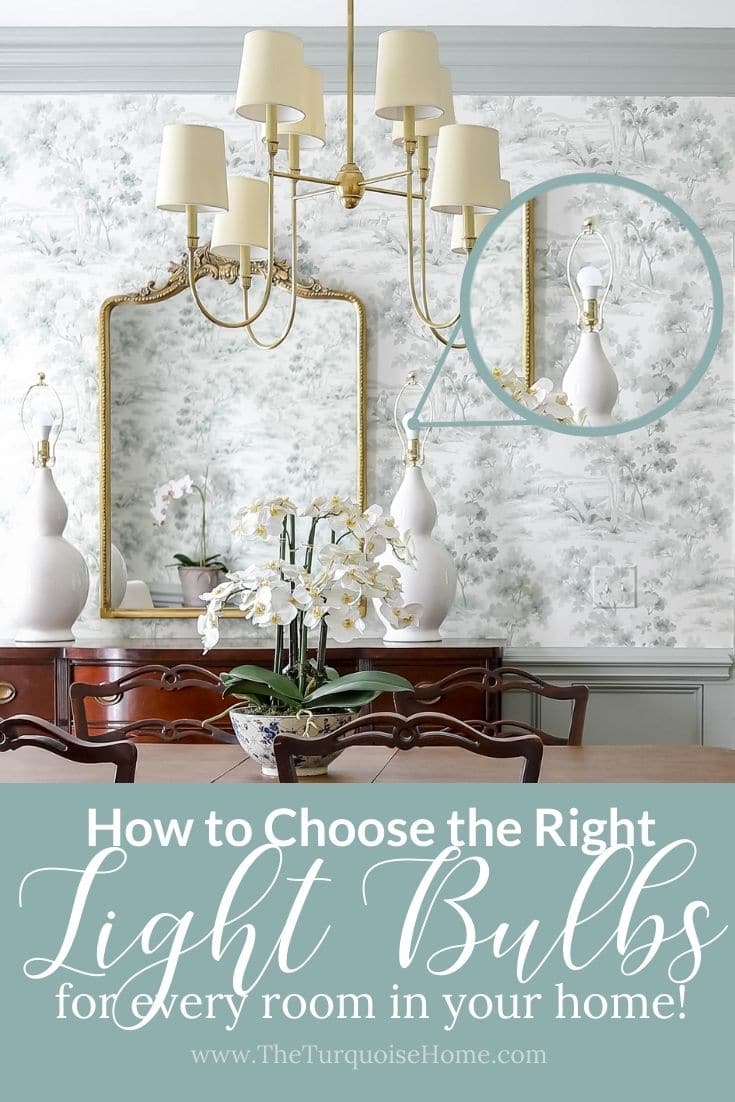
If you've visited the store for light bulbs in the last few years, you've probably noticed that the lighting industry has been revolutionized. Traditional energy-wasting incandescent bulbs no longer dominate the aisle, thanks to more efficient LEDs and other options.

Remember when we used to bring our old bulb to the store to make sure we found an exact match? Depending on how old your bulb is, finding a replacement may not be as simple these days!
So how do you choose the best light bulbs for your home? It takes a little science and some practical knowledge. I'm going to break it all down and make it simple for you.
Many new bulbs list a watt-equivalent on the packaging, but that isn't quite an apples-to-apples comparison. You need a bit more knowledge than the watt-equivalent alone to get the right bulb!
Let's dive in and discover how to choose the best bulbs for every room so you can create the ambiance you crave. Believe it or not, the right lighting can make or break your space!
I love sharing my best tips and tools for DIY with you! I've shown you how to remove drywall anchors and how to change a light fixture, as well as my top 5 tools for a beginner DIYer! I hope these help you create a home you love on a budget!
Lumens vs. Watts (vs. Kelvins)
First, let's cover the differences between lumens, watts, and Kelvins, since that will make everything else easier to follow as we go over light bulb options. This is the science bit I mentioned earlier!
- Lumens – the total amount of light a light source emits.
- Watts – the amount of energy a light source uses.
- Kelvins – indicates the color temperature of a light source.
Remember the old days of picking out bulbs based simply on watts (usually 40, 60, or 100)? People assumed the watt label showed how bright the bulb would shine, but it actually indicated how much energy the bulb would consume.
With the arrival of LEDs and their wide availability, bulbs that produce the same amount of light use far less energy and have lower wattage numbers.
A simple formula for converting LED watts to incandescent watts is to multiply the LED wattage by 5. For example, an LED bulb that uses 12 watts produces the equivalent of 60 watts of light from an incandescent bulb.
However, the better number to pay attention to is lumens. Light bulbs in stores range from 450 to 2600 lumens, with higher numbers indicating brighter light output.
Thankfully, manufacturers help by putting this information on product labels. You might see a label that says something like "800 lumens" or "equivalent to a 60-watt incandescent bulb."
Finally, Kelvins measure the color of light. Lower numbers (ex: 2000 Kelvin) indicate light that looks warmer (more yellow), while higher numbers (ex: 5000 Kelvin) indicate light that looks cooler (more blue). Product labels should also list the Kelvin rating of the bulb.
See? I told you there was some science involved!
The Best Light Bulbs by Type (and Energy Consumption)
These days you'll find four common types of light bulbs in stores: incandescent, compact fluorescent (CFL), light-emitting diode (LED), and halogen.
Incandescent Light Bulbs
These have long been the most commonly used light bulbs and are the least expensive to buy. They use a thin heated wire filament to give off warm light, contain no mercury, and work with dimmers.
Although they were once the industry standard, they're quickly becoming dinosaurs. They aren't as energy-efficient as other bulbs, and they only last about a year before they need replacing.
Since laws now require more energy-efficient bulbs, standard incandescent bulbs are being phased out. However, you can still find specialty options (ex: chandelier bulbs).
Compact Fluorescent (CFL Bulb)
These energy-efficient bulbs contain a mercury-based gas that lights up when electricity flows through the bulb and heats the gas. They take a little time to warm up and reach full brightness, but they last longer than incandescent bulbs, use much less energy, and give off about 75% less heat.
Another plus is that once they burn out, you can recycle them at your local home improvement store. Be careful handling them, because you can accidentally expose yourself to mercury if they break.
Light-Emitting Diode (LED Bulb)
LED bulbs are semiconductors that emit light when current flows through them, as the electrons release photons (light energy).
When it comes to energy efficiency, these are by far the best light bulbs. They cost more up front, but they're quickly becoming the most common bulbs in homes for several reasons.
- The most energy-efficient option (uses 75% less energy).
- Doesn't contain mercury.
- Emits bright light.
- Doesn't give off heat.
- Lasts 25 times longer than incandescent bulbs.
Halogen
Halogen bulbs are a mixed bag of pros and cons. They use a heated filament similar to incandescents, get very hot, and have the shortest lifespan. However, they're energy-efficient, dimmable, and emit a bright, daylight-white light.
If you're searching for the best light bulbs for your home, these aren't a great choice. They work well as outdoor or workshop lights, though.
Choosing the Best Light Bulbs by Shape
You'll find many shapes and styles of light bulbs to fit your lighting needs. The best bulbs have a base that fits your fixture and a shape that complements your decor. The shape of a bulb hidden inside a lampshade may not matter visually as much, but it definitely matters in a chandelier.
If you're replacing a broken bulb, take the old one with you to the store to find the correct replacement.
Shop My Favorite Light Bulbs I Use in My Home:
How to Choose the Best Light Bulbs for Home by Room
Start by thinking about how you use each space. For example, your living room is a place to relax, so you may not want bright lights glaring at you. The kitchen, on the other hand, is a workspace where you want to fill the room with light so you can see clearly.
Beyond brightness, think about the color of the light. Bulbs with lower Kelvins give off softer, moodier light that suits a room's atmosphere. Bulbs with higher Kelvins emit cool, bright light that's better for tasks.
I find that 3000 Kelvins (a neutral color) works well throughout my house, and I vary the lumens based on each room's lighting needs. Keeping the Kelvin rating the same throughout the house helps create a cohesive ambiance for your home.
The Best Light Bulbs for the Kitchen
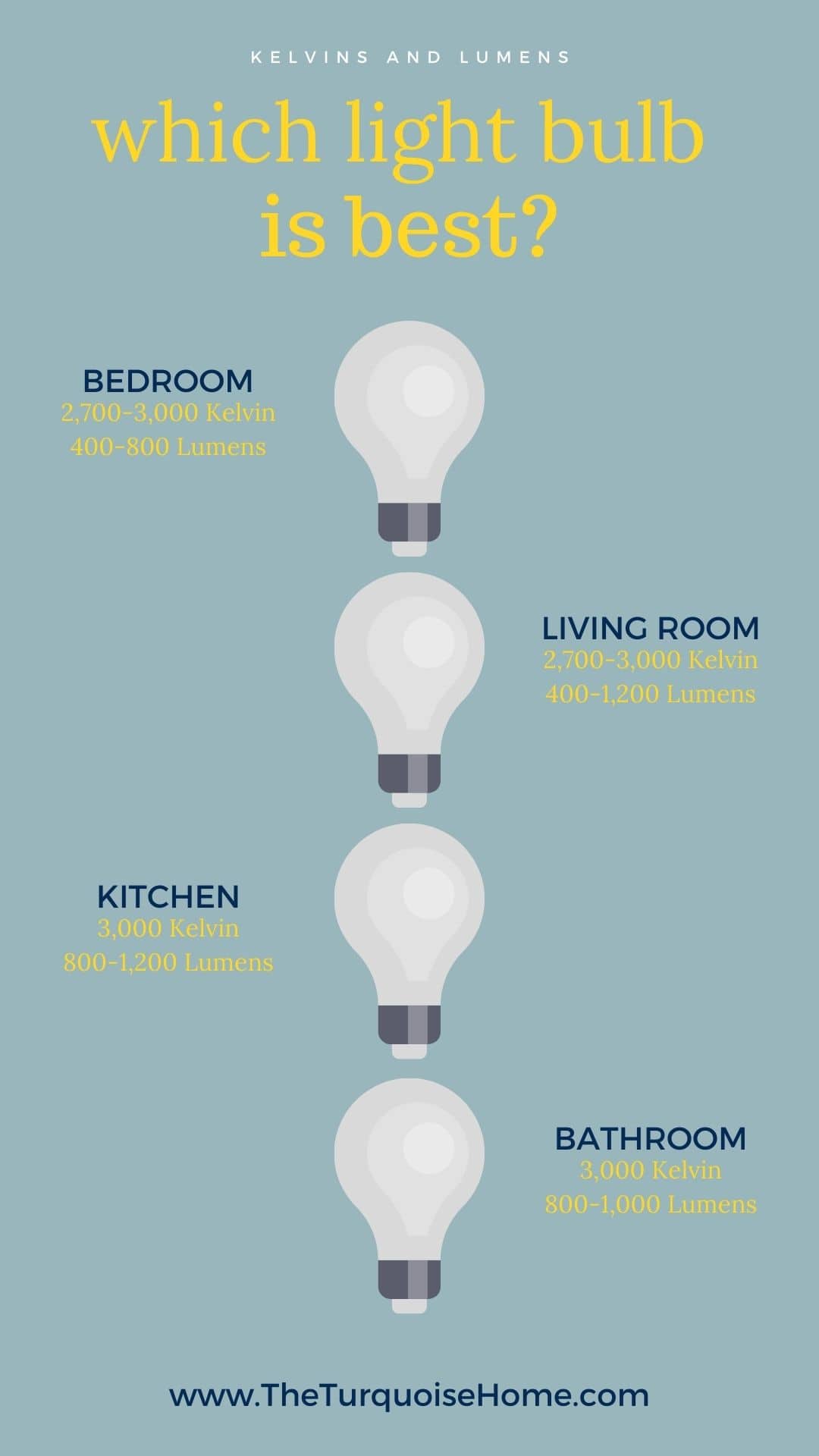
Since the kitchen is the heart of the home and a heavy-duty workspace, you'll want bright lighting and several light fixtures in that room. I recommend aiming for 800 to 1,200 lumens here.
This also depends on the natural light in the kitchen. Go higher on lumens if you don't get much natural light or do a lot of cooking after dark.
I use these can lights in my kitchen and these candelabra bulbs in my chandelier.
The Best Light Bulbs for the Bedroom
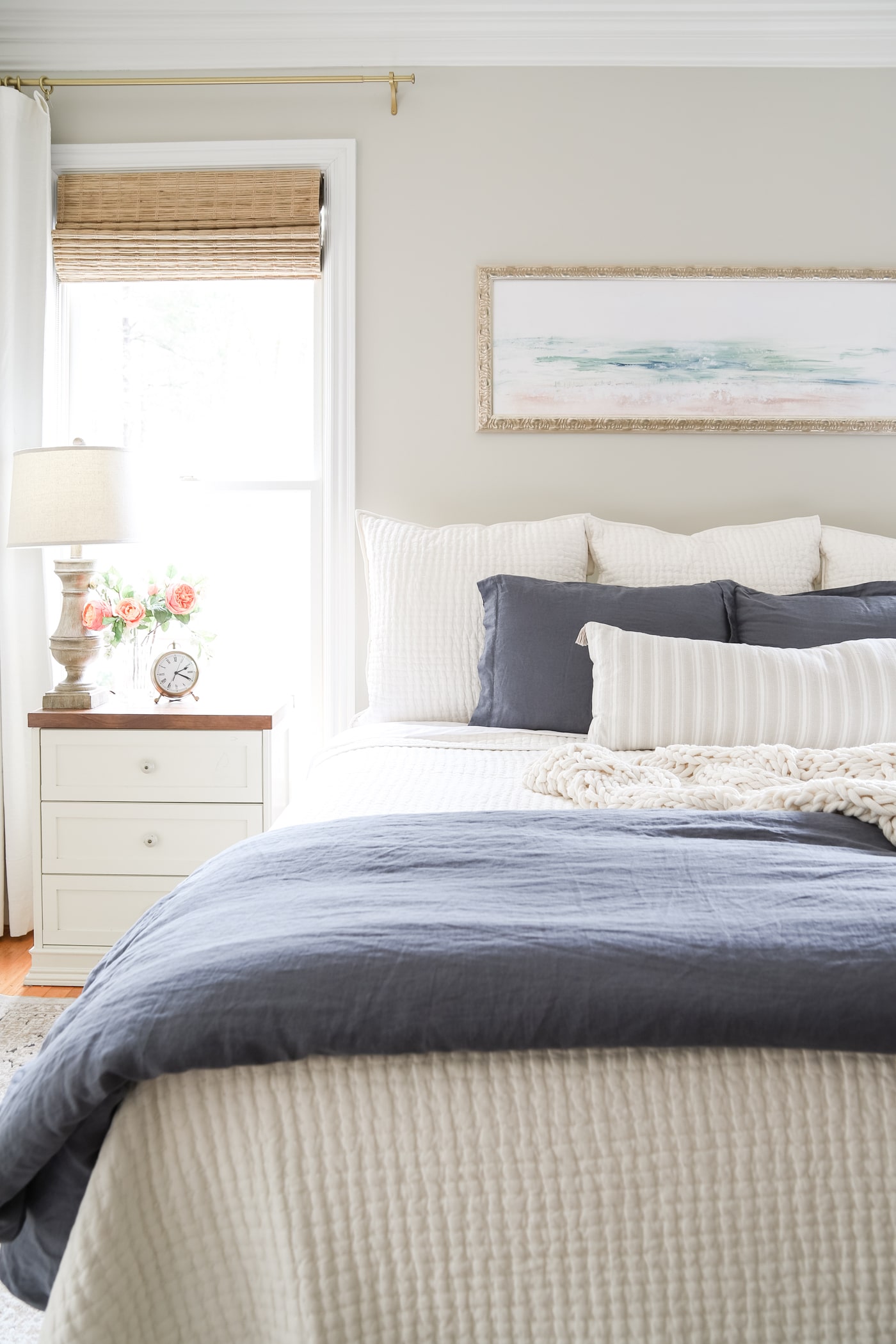
Keep bedroom lighting a soft white to promote rest and make it easier to fall asleep. Sticking to 800 lumens or less is a good rule of thumb in the bedroom. You can even lower the Kelvins to 2700. These are great bulbs for bedrooms.
However, if you read or have kids who do homework in their rooms, you may want brighter task lighting, like a desk lamp.
The Best Light Bulbs for the Bathroom
I like my bathroom lighting brighter than my bedroom lighting so I can see well enough to brush my teeth and do other tasks. I recommend 800 to 1,000 lumens in the bathroom.
I also prefer a dimmer switch in bathrooms, so a trip to the restroom in the middle of the night isn't so glaring!
The Best Light Bulbs for the Living Room
The living room's lighting needs will vary based on how you use it. I recommend a range of 400 to 1,200 lumens.
If your living room has high, vaulted ceilings and you entertain often, you may opt for around 1,000 lumens. If you mainly use the space to relax and watch TV, aim for something like 750 lumens or less.
The Best Smart Light Bulbs
The beauty of a smart light bulb is that it can change color and brightness from an app on your phone! The downside is that they can be pricey.
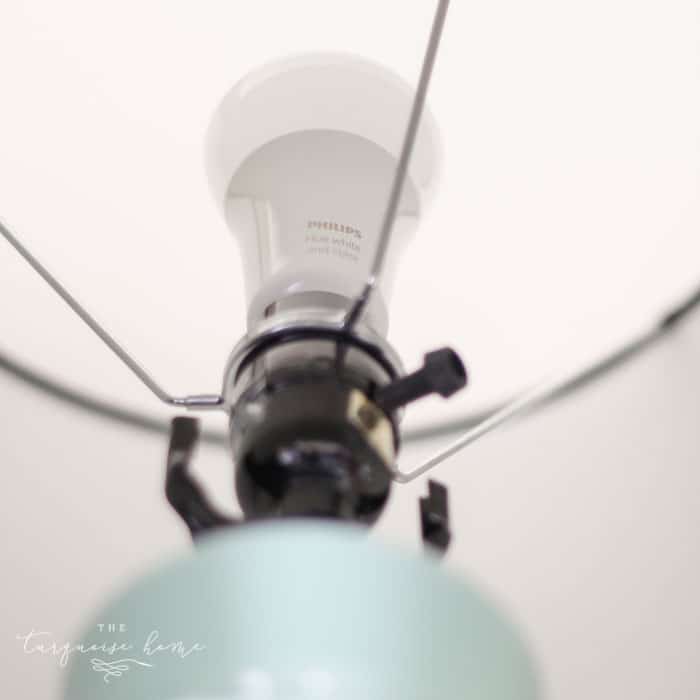
I've used and loved Philips Hue smart bulbs. I have them in my living room and bedroom lamps for perfectly controlled color and brightness. They can also turn on and off on a schedule. But, again, they're pricier and require a smart hub to communicate between the app and the bulb.
I was initially worried the bulbs would burn out quickly, but they have all lasted more than 6 years and are still going strong. I'm happy with their longevity!
Another option I love is a smart plug instead of a smart bulb. A smart plug won't let you change the color or brightness of the bulb (so choose the right one), but it will let you set a schedule for when the lights turn on and off.
I've used and loved this smart plug for all of the lamps in my home.
Final Thoughts
Ultimately, choosing the best light bulbs for your home means weighing several factors. Your light fixtures, bulb type, lamp shades, color temperature, and how you use each space all play a part.
You'll also notice your paint colors may shift in hue simply by swapping out a light bulb!
In general, I stick with 400 to 800 lumens in most rooms in my home. I use fewer lumens in the living room and bedrooms, and more in the kitchen and bathrooms!
Feel free to experiment with your lighting by adjusting the Kelvin and lumen levels until you find the balance between ambiance and task lighting that works for you.
More Posts You Will Love: