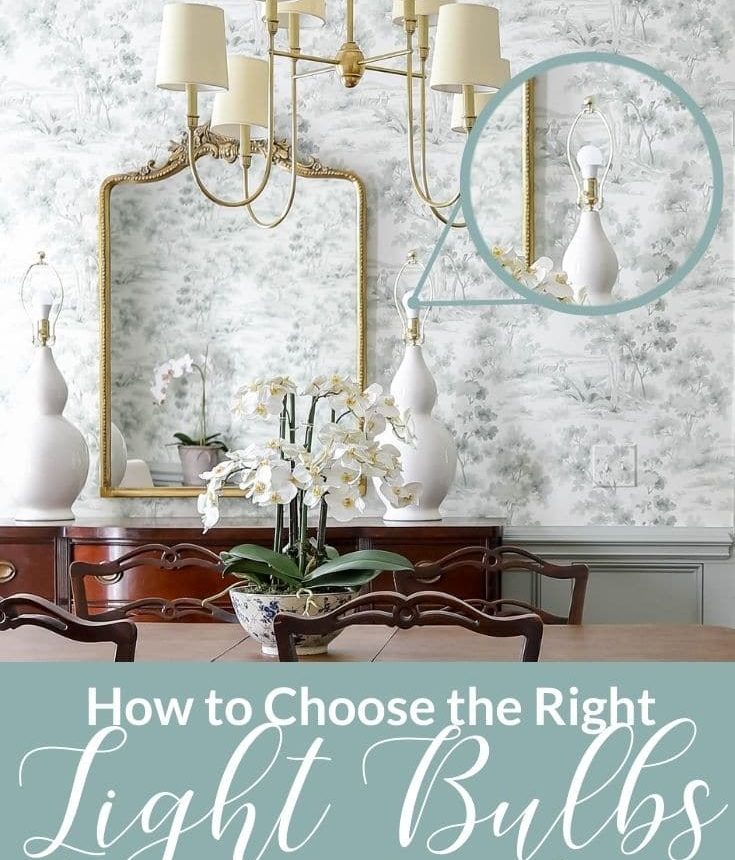
Picking the best light bulbs for your home is part science and part art, and it can have a significant impact on the atmosphere and mood in your home. Learn how to simplify the process so you choose the best light bulbs for every room.
Once you choose the right lamps or chandeliers for your home, it’s time to select the best light bulbs to use in them. Using the proper light bulbs in each room and fixture can dramatically change the ambiance of your space.
If you’ve visited the light bulb aisle recently, you’ve probably noticed a lighting revolution. Traditional incandescent bulbs are no longer the only option, and energy-efficient LEDs and other modern alternatives now dominate the market.
Gone are the days when you brought an old bulb to the store hoping for an exact match. With newer technologies and changing labeling, selecting the right replacement requires a bit of understanding. This guide breaks down the essentials so you can confidently pick the best light bulbs for each room.
The packaging often shows a watt-equivalent, but it’s not a perfect comparison. To choose the right bulb you’ll want to pay attention to lumens, watts, and color temperature (Kelvins), as well as bulb type and shape.
Lumens vs. Watts (vs. Kelvins)
Understanding lumens, watts, and Kelvins will make choosing bulbs much easier. This is the scientific side that helps you match brightness and color to each room’s needs.
- Lumens – the total amount of light a bulb emits (brightness).
- Watts – the amount of energy a bulb uses (power consumption).
- Kelvins – the color temperature of the light (warm to cool).
In the past, shoppers chose bulbs by wattage—40, 60, or 100 watts—assuming wattage indicated brightness. Wattage actually refers to energy use. With LEDs, bulbs that produce the same light use far less energy, so their wattage numbers are lower even when the brightness is the same.
LEDs are much more efficient: a lower wattage LED can produce the same lumens as a higher wattage incandescent. A quick rule of thumb is that an LED uses roughly one fifth the wattage of an equivalent incandescent. For example, a 12-watt LED commonly produces light similar to a 60-watt incandescent.
Lumens are the better measure of brightness. Typical household bulbs range from about 450 to 2600 lumens. The higher the lumens, the brighter the bulb.
Kelvin ratings describe color temperature. Lower Kelvin numbers (around 2700–3000 K) appear warm and yellowish, ideal for cozy areas. Higher numbers (4000–5000 K) are cooler and bluer, better for task lighting or workspaces. Many product labels include lumens and Kelvin values to help you compare bulbs.
The Best Light Bulbs by Type (and Energy Consumption)
Today the four common bulb types are incandescent, compact fluorescent (CFL), light-emitting diode (LED), and halogen. Each has its pros and cons depending on budget, energy use, and desired light quality.
Incandescent Light Bulbs
Incandescent bulbs produce a warm light using a heated filament. They are inexpensive to buy and generally compatible with dimmers, but they are much less energy-efficient and have shorter lifespans than modern alternatives. Many standard incandescent bulbs are being phased out in favor of more efficient options, though specialty shapes can still be found.
Compact Fluorescent (CFL)
CFLs use a mercury-containing gas that lights up when energized. They’re more energy-efficient and longer-lasting than incandescents, but they take time to reach full brightness and require careful handling and recycling due to mercury content.
Light-Emitting Diode (LED)
LEDs are semiconductors that emit light when an electrical current passes through them. They are the most energy-efficient household option, use far less energy, do not contain mercury, emit minimal heat, and last many times longer than incandescent bulbs. While more expensive up-front, LEDs usually save money over time through lower energy use and longer life.
- Very energy-efficient (use substantially less energy).
- No mercury content.
- Available in a wide range of brightness and color temperatures.
- Produce little heat and have long lifespans.
Halogen
Halogen bulbs are a type of incandescent that produces bright, white light. They get hot and have shorter lifespans, but they are dimmable and provide crisp, daylight-like light. They can be useful outdoors or in workshop settings, but they are generally not the most energy-efficient choice for everyday home lighting.
Choosing the Best Light Bulbs by Shape
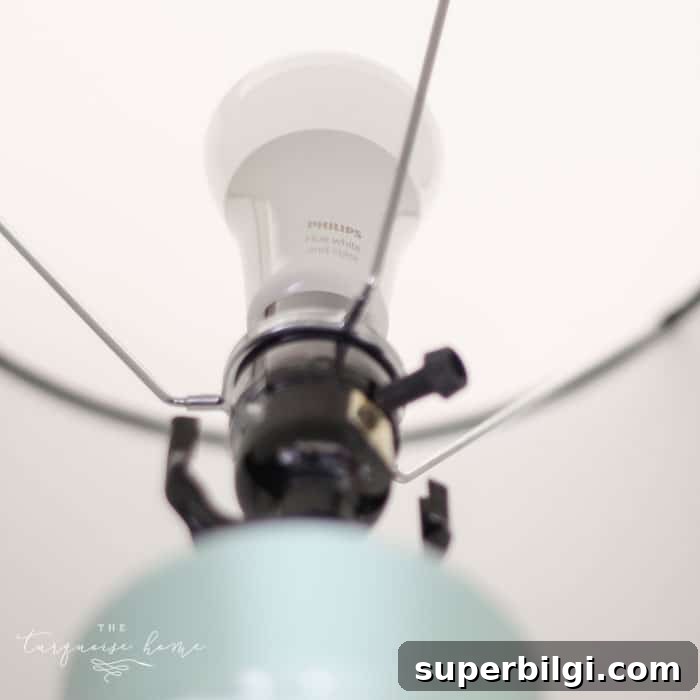
Bulbs come in many shapes to fit different fixtures. The most important considerations are a base that fits your fixture and a bulb shape that complements the fixture’s look. The visible shape matters most in open fixtures like chandeliers, while for lamps with shades the internal shape matters less. When replacing a broken bulb, taking the old bulb with you can make finding the correct replacement much simpler.
How to Choose the Best Light Bulbs for Home by Room
Start by thinking about how you use each space. Living rooms are often for relaxing, so softer light is better. Kitchens are work areas that need brighter, clearer light. Consider both brightness (lumens) and color temperature (Kelvins) when choosing bulbs for each room.
Keeping the Kelvin rating consistent throughout the house—such as a neutral 3000 K—creates a cohesive feel. Then vary lumens per room depending on task needs: lower for relaxing spaces, higher for work areas.
The Best Light Bulbs for the Kitchen
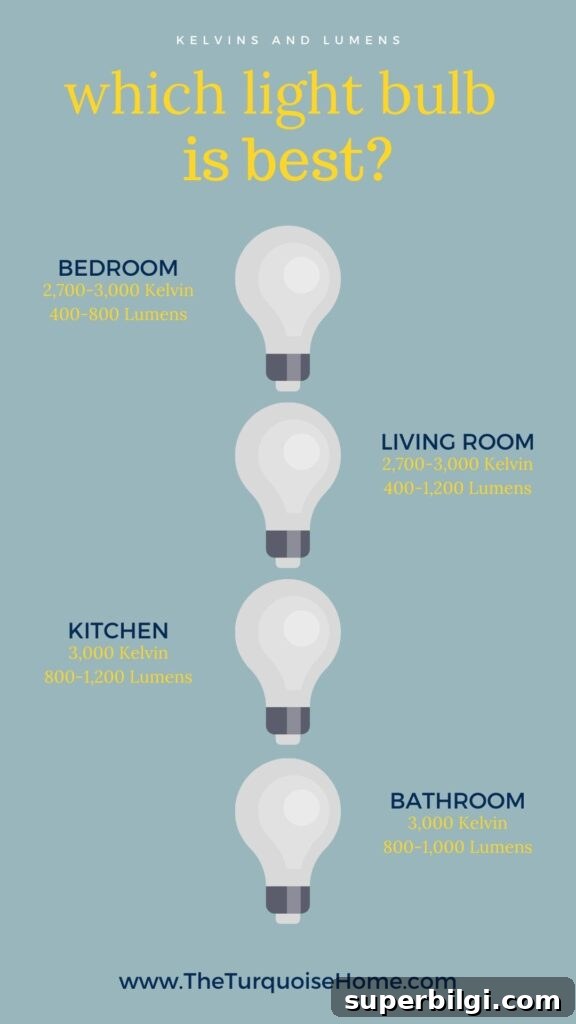
The kitchen is both the heart of the home and a workspace, so aim for bright, even lighting. Target roughly 800–1,200 lumens for general lighting, adjusting upward if you have limited natural light or do a lot of evening cooking. Use task lighting under cabinets and over work surfaces to reduce shadows and improve visibility.
The Best Light Bulbs for the Bedroom
For bedrooms, choose softer white light to promote rest. Keep general lighting to about 800 lumens or less and consider a warmer color temperature like 2700 K for a cozy feel. Add brighter task lighting—for example at a desk or reading chair—where needed so the overall room remains restful while still functional.
The Best Light Bulbs for the Bathroom
Bathrooms benefit from brighter lighting than bedrooms to support grooming and hygiene tasks. Aim for about 800–1,000 lumens in general fixtures and consider adding focused lighting around mirrors. A dimmer switch is a helpful addition for nighttime use to reduce glare.
The Best Light Bulbs for the Living Room
Living room lighting needs depend on use. For relaxed lounging and TV-watching, lower lumens (400–750) work well. For entertaining or rooms with high ceilings, you may want brighter lighting around 1,000–1,200 lumens. Layered lighting—ambient, task, and accent—creates flexibility and a pleasing atmosphere.
Smart Light Bulbs and Alternatives
Smart bulbs let you change color and brightness from a phone app or voice assistant, offering great flexibility for mood and task lighting. They can be costlier and often work best with a hub or compatible system. Many people also use smart plugs as a budget-friendly alternative to automate on/off schedules for conventional bulbs—this adds scheduling and remote control without replacing every bulb with a smart version.
Final Thoughts
Choosing the best light bulbs for your home means balancing fixture types, bulb technologies, bulb shapes, color temperature, and how each room is used. Changing a bulb can subtly alter how paint colors look and how a room feels, so experimentation with Kelvin and lumen levels is encouraged until you find what feels right.
As a practical baseline, many homeowners find 3000 K (neutral) across the house provides a cohesive look, with 400–800 lumens in general living spaces and higher lumens in kitchens and bathrooms. Use dimmers and layered lighting to adapt spaces for relaxation, tasks, and entertaining.
Summary: Prioritize lumens for brightness, watts for energy use, and Kelvins for color temperature. Choose LED bulbs for energy efficiency and longevity when possible, match bulb shape and base to the fixture, and adjust lumen and Kelvin values by room to create the desired ambiance and function.
More posts you will enjoy:
- 15 Best Ceiling Fans for the Stylish Home
- 15 Flush Mount Lighting Ideas For Your Home
- 25+ Amazing Table Lamps For Your Home
- 17 Beautiful Dining Room Chandeliers
- Modern Wall Sconces for Every Budget