
Choosing the best light bulbs for your home is part science and part art, and it can dramatically influence the mood and atmosphere of every room. This guide will simplify the process so you can confidently pick the right bulbs for each space.
After selecting new lamps or chandeliers for your rooms, the next step is choosing the right bulbs. The proper bulbs in each room—and in each fixture—can transform how your home looks and feels.
If you’ve shopped for light bulbs recently, you’ve likely noticed big changes on the bulb aisle. Traditional incandescent bulbs have largely been replaced by more energy-efficient options like LEDs and compact fluorescents. That shift means choosing the right bulb now takes a little more knowledge than it used to.
The good news is that with a few basic concepts and practical tips, you can easily pick the bulbs that deliver the right brightness, color, and energy efficiency for each room.
Gone are the days when you matched bulbs by wattage alone. Today’s bulbs often list a watt-equivalent, but that doesn’t tell the full story. Read on to understand lumens, watts, and kelvins, and how to select bulbs by type, shape, and room function.
Lumens vs. Watts vs. Kelvins
Understanding lumens, watts, and kelvins will make bulb shopping much clearer. This is the science part that helps you compare different bulbs accurately.
- Lumens – the total amount of visible light emitted by the bulb. Higher lumens = brighter light.
- Watts – the amount of energy the bulb consumes. With modern bulbs, low wattage can still produce high brightness.
- Kelvins – the color temperature of the light. Lower kelvins look warm and yellow, higher kelvins look cool and blue.
People used to choose bulbs by wattage—40, 60, 100—thinking that number indicated brightness. In reality, wattage tells you energy usage. With LEDs, bulbs that produce the same light output use far less energy than incandescents. A rough conversion is to multiply LED wattage by about 5 to estimate its incandescent equivalent (for example, a 12W LED approximates a 60W incandescent).
Lumens are a more reliable measure of brightness. Bulbs commonly range from around 450 lumens for softer lighting to 2,600 lumens or more for very bright fixtures. You’ll often see product labels that show both lumens and a watt-equivalent.
Kelvins measure color temperature. Around 2700K produces a warm, cozy glow; 3000K is a neutral white; 4000–5000K looks cooler and more daylight-like, which is useful for task lighting.
Best Light Bulbs by Type and Energy Use
Four common bulb types are available: incandescent, compact fluorescent (CFL), light-emitting diode (LED), and halogen. Each has pros and cons to consider.
Incandescent
Incandescent bulbs have been popular because they’re inexpensive and deliver a warm light. They work with dimmers and don’t contain mercury. However, they’re inefficient and have short lifespans compared with newer options. Production of standard incandescents has been reduced in favor of more efficient bulbs, though specialty styles are still available.
Compact Fluorescent (CFL)
CFLs use less energy than incandescents and last longer, but they contain a small amount of mercury and can take time to reach full brightness. They should be handled with care and recycled properly when they burn out.
LED
LED bulbs are the most energy-efficient option available. They use far less energy, last many times longer than incandescents, produce minimal heat, and don’t contain mercury. Although LEDs cost more upfront, their efficiency and long life make them the best overall choice for most home applications.
- Very energy-efficient—use significantly less energy than incandescent bulbs.
- Contain no mercury.
- Provide bright, consistent light.
- Run cool and last many years with normal use.
Halogen
Halogen bulbs are a type of incandescent with a slightly higher efficiency and a very bright, white light. They run hot and have shorter lifespans than LEDs. Halogens can be useful outdoors or in work areas but are less practical for general home lighting today.
Choosing Bulb Shape and Base
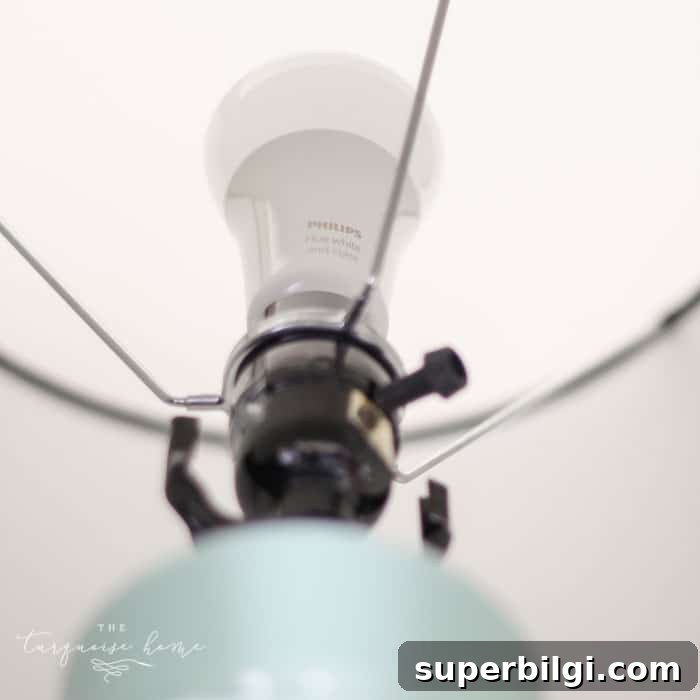
Bulb shape and base need to match your fixtures and complement the look of the room. Common bases include medium (for most lamps and fixtures) and candelabra (for chandeliers). For visible fixtures like chandeliers, the shape and finish matter visually; inside a covered lamp, shape matters less.
If you’re replacing a bulb, bring the old one to the store or check the fixture label to confirm the correct base and maximum wattage.
Choose Bulbs by Room and Use
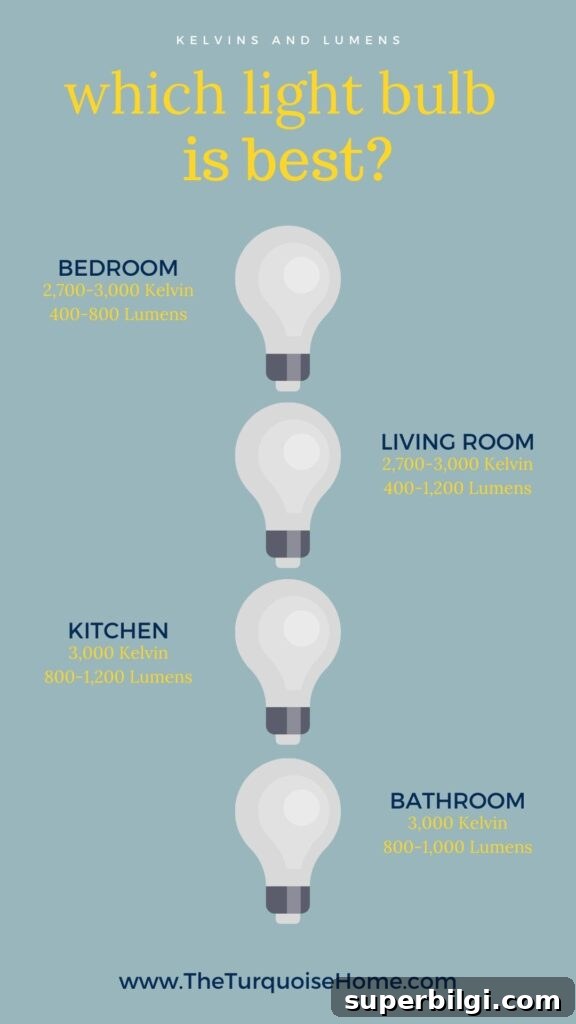
Think about how you use each room. Living rooms are for relaxation, so softer light and lower brightness are generally preferable. Kitchens and workspaces need brighter, cooler light for tasks. Matching Kelvin values throughout the home—such as using 3000K as a neutral standard—creates a cohesive feel, while varying lumens by room meets functional needs.
Kitchen
Kitchens are high-use workspaces that benefit from bright, layered lighting. Aim for roughly 800–1,200 lumens for general overhead fixtures, with task lighting (under-cabinet or over counters) added where needed. Increase lumen output if natural light is limited or you cook frequently at night.
Bedroom
Bedrooms should feel calm and inviting. Softer, warm light is best—generally 800 lumens or less and a color temperature around 2700–3000K. Use brighter task lighting only where needed (reading lamps or desks).
Bathroom
Bathrooms benefit from brighter, clearer light for grooming. Aim for 800–1,000 lumens for general lighting and consider a dimmer for nighttime use to avoid harsh glare.
Living Room
Living room lighting depends on how you use the space. A range from 400 to 1,200 lumens covers most needs: lower for relaxing and TV viewing, higher for entertaining or reading. Layered lighting—ambient, task, and accent—creates flexibility and the best overall effect.
Smart Bulbs and Smart Plugs
Smart bulbs let you change color and brightness from an app or voice assistant and can be scheduled. They are more expensive but very flexible. Some popular options require a hub for full functionality, while others connect directly via Wi-Fi.
An alternative is using a smart plug with a regular bulb. Smart plugs allow scheduling and remote on/off control but do not change bulb color or dimming. They are a cost-effective way to add automation to lamps and fixtures that don’t require color control.
Final Thoughts
Choosing the best bulbs for your home means balancing fixture compatibility, bulb type, color temperature, and brightness based on each room’s needs. Your paint and finishes can look different under varying light, so experiment with kelvins and lumens until you achieve the right combination of ambiance and task lighting.
A practical starting point is to use 3000K for a consistent neutral tone throughout your home and select lumens according to room function—lower in living rooms and bedrooms, higher in kitchens and bathrooms. LEDs are generally the best overall choice for efficiency and longevity.
More posts you will love:
- 15 Best Ceiling Fans for the Stylish Home
- 15 Flush Mount Lighting Ideas for Your Home
- 25+ Amazing Table Lamps for Your Home
- 17 Beautiful Dining Room Chandeliers
- Modern Wall Sconces for Every Budget